Peptide Stability & Degradation: How Temperature, Light and Reconstitution Affect Research Results
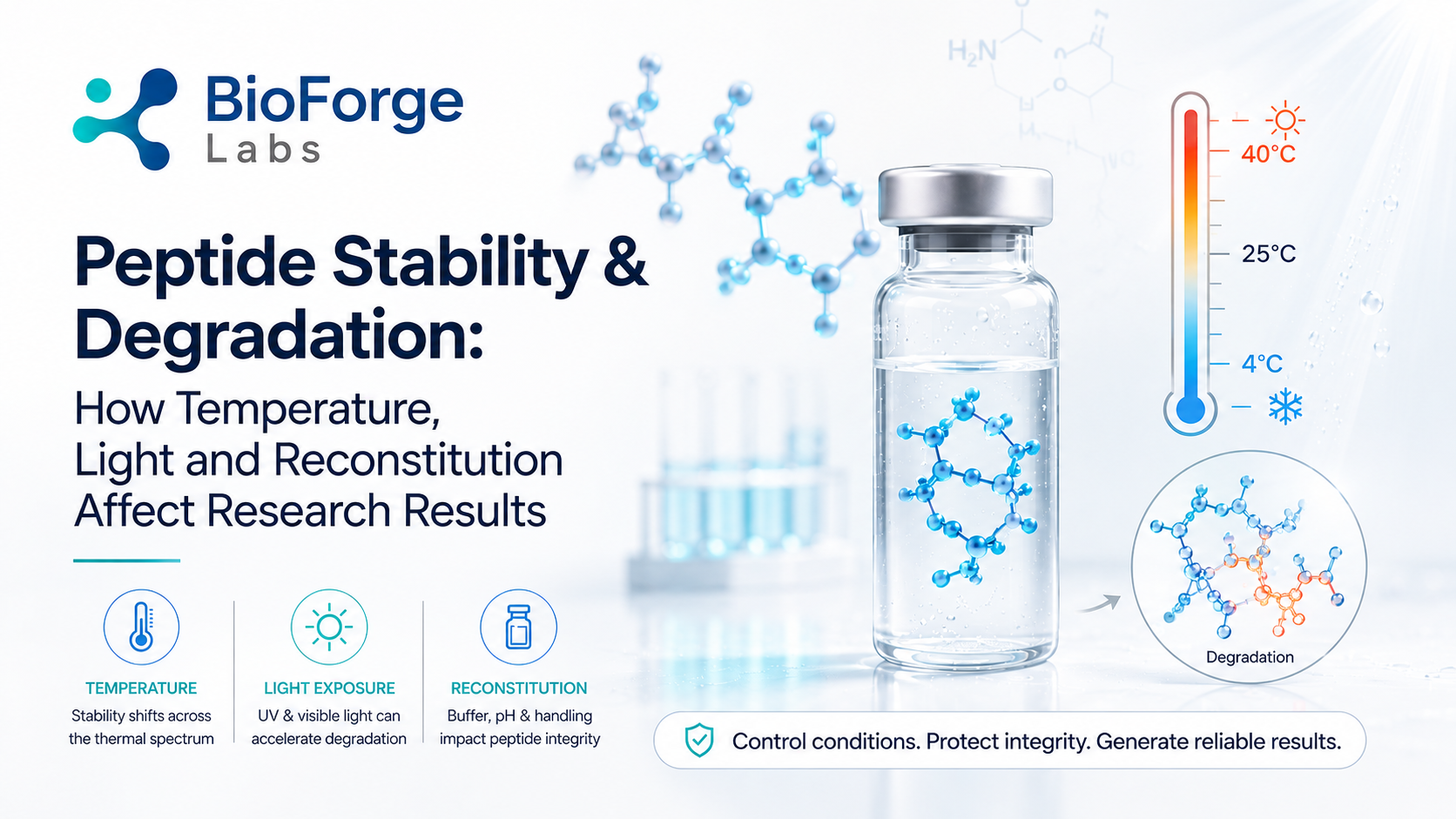
Peptide stability is one of the most critical, yet often underestimated, factors in laboratory research. Even high-purity research peptides can lose integrity when exposed to suboptimal conditions of temperature, light, moisture, or improper reconstitution practices. Understanding the chemistry of degradation and the practical steps required to minimise it is essential for obtaining reliable, reproducible experimental results.
This comprehensive guide examines the major degradation pathways affecting research peptides, the influence of temperature and light, the dramatic change in stability that occurs upon reconstitution, and best-practice recommendations for Australian laboratories in 2026.
Why Peptide Stability Matters
Peptides are chains of amino acids linked by peptide bonds. In their lyophilized (freeze-dried) form they exist as a low-mobility solid, which significantly slows most chemical reactions. Once water is introduced during reconstitution, molecular mobility increases and a range of degradation pathways become active.
Degraded peptides can lead to:
- Reduced purity and biological activity in assays
- Formation of impurities that interfere with experimental readouts
- Inconsistent or non-reproducible results across experiments
- Wasted research materials, time, and resources
For laboratories conducting quantitative or comparative studies, maintaining peptide integrity from receipt through to final use is fundamental to data quality.
Major Chemical and Physical Degradation Pathways
1. Hydrolysis Water can cleave the peptide backbone, particularly at aspartate-proline (Asp-Pro) sequences, which are especially susceptible to acid-catalyzed hydrolysis. Higher temperatures and extreme pH accelerate this process.
2. Oxidation Amino acid residues such as methionine (Met), cysteine (Cys), tryptophan (Trp), tyrosine (Tyr), and histidine (His) are prone to oxidation. Exposure to atmospheric oxygen, trace metal ions, or light markedly increases the rate of oxidative damage.
3. Deamidation Asparagine (Asn) and glutamine (Gln) residues can undergo deamidation, converting the amide side chain into a carboxylic acid. This reaction is strongly influenced by pH (accelerated above pH 6), temperature, and the presence of neighboring residues such as glycine. Deamidation alters both charge and structure.
4. Aggregation and Physical Instability Peptides can form soluble aggregates or insoluble precipitates. Repeated freeze-thaw cycles, high concentrations, and certain surface interactions promote aggregation, which can reduce available active peptide and complicate experimental interpretation.
5. Photodegradation UV and short-wavelength visible light can initiate photochemical reactions, particularly oxidation of aromatic residues. Light exposure is an independent risk factor that compounds the effects of temperature and oxygen.
6. Disulfide Scrambling and Racemization In peptides containing cysteine residues, disulfide bonds can rearrange under certain conditions. Racemization of amino acids can also occur, especially at elevated temperatures or non-optimal pH.
Temperature: The Dominant Stability Factor
Temperature exerts the strongest influence on peptide degradation rates. Many chemical degradation reactions approximately double for every 10°C rise in temperature (a practical application of the Arrhenius relationship).
Practical Storage Guidelines for Research Peptides:
| Form | Recommended Temperature | Typical Stability Window | Notes |
|---|---|---|---|
| Lyophilized powder | -20°C | 1–5+ years | Standard long-term storage |
| Lyophilized powder | -80°C | Maximum stability (many years) | Ideal for archival stocks |
| Lyophilized powder | 2–8°C | Months | Acceptable short-term only |
| Reconstituted solution | 2–8°C | Days to ~4 weeks (sequence-dependent) | Primary working storage |
| Reconstituted solution | Room temperature | Hours to a few days | Avoid extended exposure |
| Reconstituted solution | >30°C | Rapid degradation | Highly detrimental |
Lyophilized peptides stored cold, dry, and protected from light generally retain high purity for years. Once reconstituted, the stability window shortens dramatically because water enables aqueous degradation chemistry.
Light Exposure and Photodegradation
Light, especially UV and blue wavelengths, accelerates oxidation of susceptible amino acids. Best laboratory practice includes:
- Storing peptides in the dark or in amber vials
- Minimising time spent under laboratory lighting during weighing and reconstitution
- Using foil wrapping for particularly light-sensitive sequences when necessary
- Avoiding direct sunlight or strong artificial light sources near peptide work areas
Even relatively brief exposure can contribute to cumulative degradation over multiple handling steps.
The Critical Transition: Reconstitution
Reconstitution is the point at which peptide stability changes most dramatically. Removing water during lyophilization largely arrests hydrolytic and many other aqueous pathways. Adding water restarts those pathways.
Best-Practice Reconstitution Guidelines for Research Use:
- Reconstitute only the quantity required for the planned experimental period
- Use high-quality bacteriostatic water or sterile water under strict aseptic technique
- Allow the lyophilized cake to dissolve fully without excessive agitation or heat
- Avoid repeated freeze-thaw cycles of the reconstituted solution — aliquot into single-use portions if multiple experiments are planned
- Store reconstituted solutions at 2–8°C and protect from light
- Clearly label vials with peptide identity, concentration, reconstitution date, and solvent used
- Discard according to laboratory protocols at the end of the validated use period
The exact usable lifetime of a reconstituted peptide depends on its sequence, concentration, solvent, pH, and storage conditions. Sensitive sequences may require shorter use windows.
Additional Factors Influencing Stability
Moisture Lyophilized peptides are hygroscopic. Exposure to atmospheric humidity can introduce residual moisture that accelerates degradation even before formal reconstitution. Always allow vials to reach ambient temperature in a desiccator or controlled environment before opening, and reseal tightly.
pH The pH of the reconstitution solvent influences the rate of deamidation, hydrolysis, and racemization. Most research peptides perform best in the mildly acidic to neutral range. Bacteriostatic water is typically suitable for many common research peptides.
Oxygen and Metal Ions Oxidation is promoted by dissolved oxygen and trace metals. Minimising headspace air and avoiding metal-contaminated equipment can help reduce oxidative loss.
Australian Laboratory Context
Australia’s climate presents additional practical challenges. Higher ambient temperatures increase the risk of degradation during shipping and short-term handling. Researchers benefit from:
- Domestic suppliers who understand cold-chain requirements
- Prompt transfer of received material into -20°C (or colder) storage
- Monitoring of laboratory refrigerator and freezer temperatures
- Clear documentation of receipt date, storage conditions, and reconstitution history
BioForge Labs Approach to Product Integrity
At BioForge Labs, we prioritise the stability of research materials through careful handling, independent batch testing, and temperature-aware express shipping from Queensland. We supply high-purity research peptides with supporting documentation so laboratories can maintain rigorous experimental standards.
All products are sold strictly for research and laboratory use only. They are not intended for human consumption, therapeutic, or veterinary purposes.
Key Takeaways for Researchers
- Temperature is the single most important controllable factor — keep lyophilized peptides at -20°C or lower.
- Lyophilized form is far more stable than reconstituted solution.
- Protect peptides from light, especially after reconstitution.
- Reconstitute only what is needed and use aseptic technique.
- Avoid repeated freeze-thaw cycles of solutions.
- Document storage and reconstitution conditions for experimental traceability.
For a detailed scientific review of peptide degradation mechanisms and forced degradation strategies used in formulation development, see: A Review on Forced Degradation Strategies to Establish the Stability of Therapeutic Peptide Formulations
Final Thoughts
Peptide stability is not guaranteed by high initial purity alone. It depends on continuous attention to temperature, light, moisture, and reconstitution practices throughout the research workflow. By understanding the main degradation pathways and applying evidence-based storage and handling procedures, researchers can significantly improve the reliability and reproducibility of their experimental results.