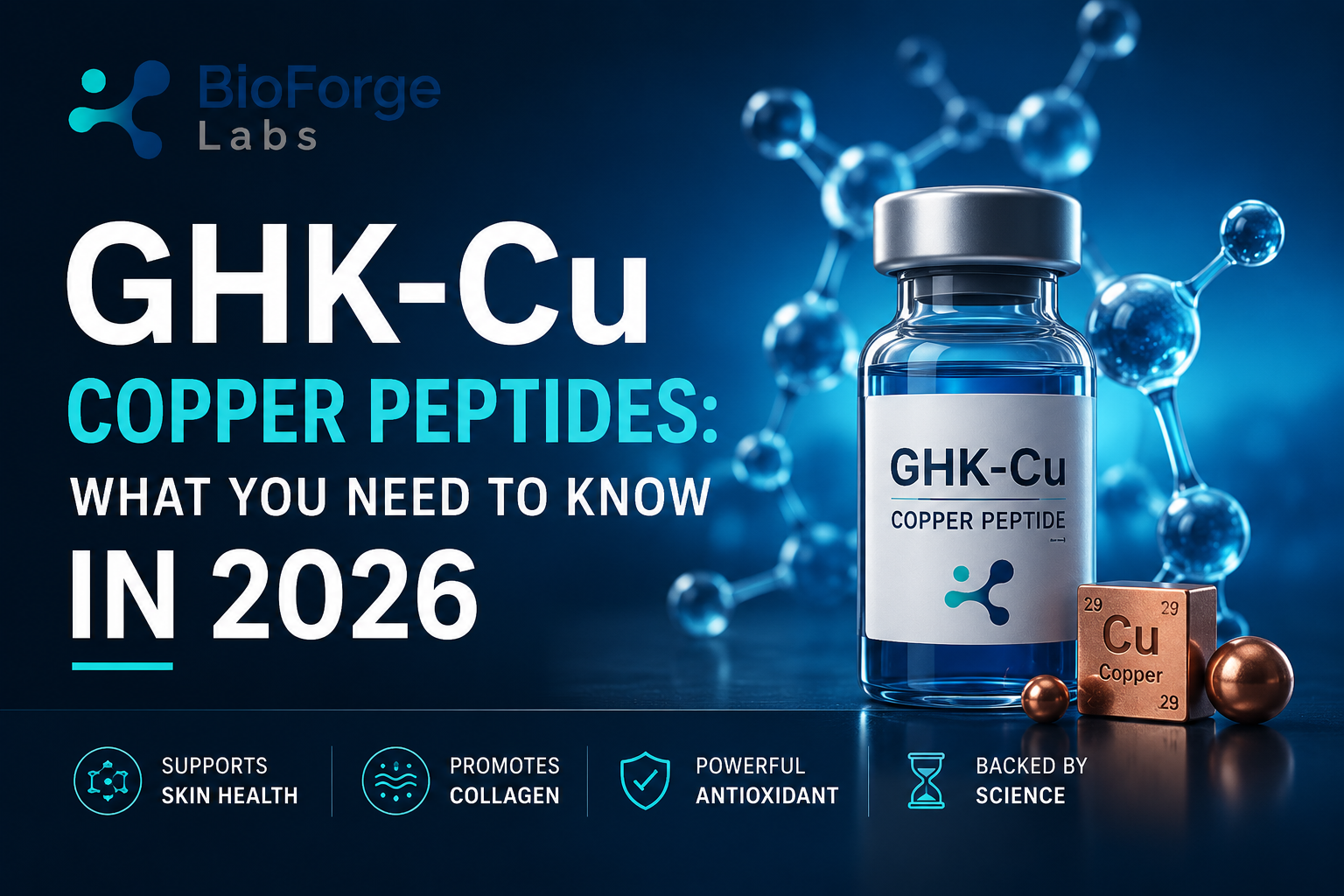
GHK-Cu (Copper Tripeptide-1) continues to be one of the most studied copper peptides in laboratory research. As interest in regenerative and cosmetic peptide research grows in 2026, GHK-Cu remains a popular compound for researchers exploring skin biology, wound healing, and anti-aging pathways.
This guide covers the current state of GHK-Cu research, its properties, and what Australian researchers should consider when sourcing this peptide.
What is GHK-Cu?
GHK-Cu is a naturally occurring tripeptide consisting of glycine, histidine, and lysine, complexed with a copper ion. It was first isolated from human plasma and has since been extensively studied in cell culture and animal models for its biological activities.
In laboratory research, GHK-Cu is primarily investigated for its potential roles in:
1. Skin and Extracellular Matrix Research GHK-Cu is frequently used in studies examining fibroblast activity, collagen synthesis, and skin remodelling. Researchers are particularly interested in its ability to support extracellular matrix components in laboratory models.
2. Wound Healing and Tissue Regeneration Multiple preclinical studies explore GHK-Cu’s effects on cell migration, angiogenesis, and tissue repair processes.
3. Antioxidant and Protective Effects The copper complex is studied for its potential to reduce oxidative stress in experimental systems.
4. Anti-Inflammatory Pathways Ongoing research examines GHK-Cu’s modulation of inflammatory markers in cell-based models.
Important Considerations for Researchers
Purity and Quality For reliable results, researchers should source GHK-Cu with documented purity of ≥98% (ideally ≥99%) verified by independent HPLC testing. Always request a recent Certificate of Analysis (CoA) from a reputable lab such as Janoshik.
Storage Recommendations GHK-Cu is relatively stable when lyophilized. Store at -20°C for long-term stability. Reconstituted solutions should be used promptly or stored appropriately according to your laboratory protocols.
Australian Research Context Australian researchers benefit from domestic suppliers who understand local shipping conditions and can provide fast, temperature-controlled delivery.
Why Researchers Choose BioForge Labs for GHK-Cu
At BioForge Labs, we supply high-purity GHK-Cu specifically for laboratory research. Every batch is independently tested, and we provide full documentation to support your experimental needs. As a Queensland-based supplier, we offer reliable Australia-wide express shipping with proper cold-chain practices.
All products are sold strictly for research and laboratory use only.
Selected Research References
Here are some key peer-reviewed studies on GHK-Cu:
Pickart, L., & Margolina, A. (2018). “Regenerative and Protective Actions of the GHK-Cu Peptide in the Light of the New Gene Data.” International Journal of Molecular Sciences. Research Article
Wang, X., et al. (2022). “The Copper-Binding Tripeptide GHK-Cu: A Review of Its Biological Effects and Applications.” Frontiers in Pharmacology.
Pickart, L., et al. (2015). “GHK Peptide as a Natural Modulator of Multiple Cellular Pathways in Skin Regeneration.” BioMed Research International.
Note: These studies are preclinical or in-vitro. GHK-Cu is sold strictly for laboratory and scientific research use only.