Peptide Purity Explained: What 98% vs 99% Actually Means for Your Experiments
When sourcing research peptides, purity is one of the most commonly discussed quality metrics. Suppliers frequently list HPLC purity as ≥98% or ≥99%. While these numbers appear straightforward, their practical meaning for laboratory experiments is often misunderstood.
This guide explains what peptide purity actually measures, how 98% and 99% differ in real research settings, the important distinction between HPLC purity and net peptide content, and why independent verification matters more than the headline percentage.
What Peptide Purity Really Measures
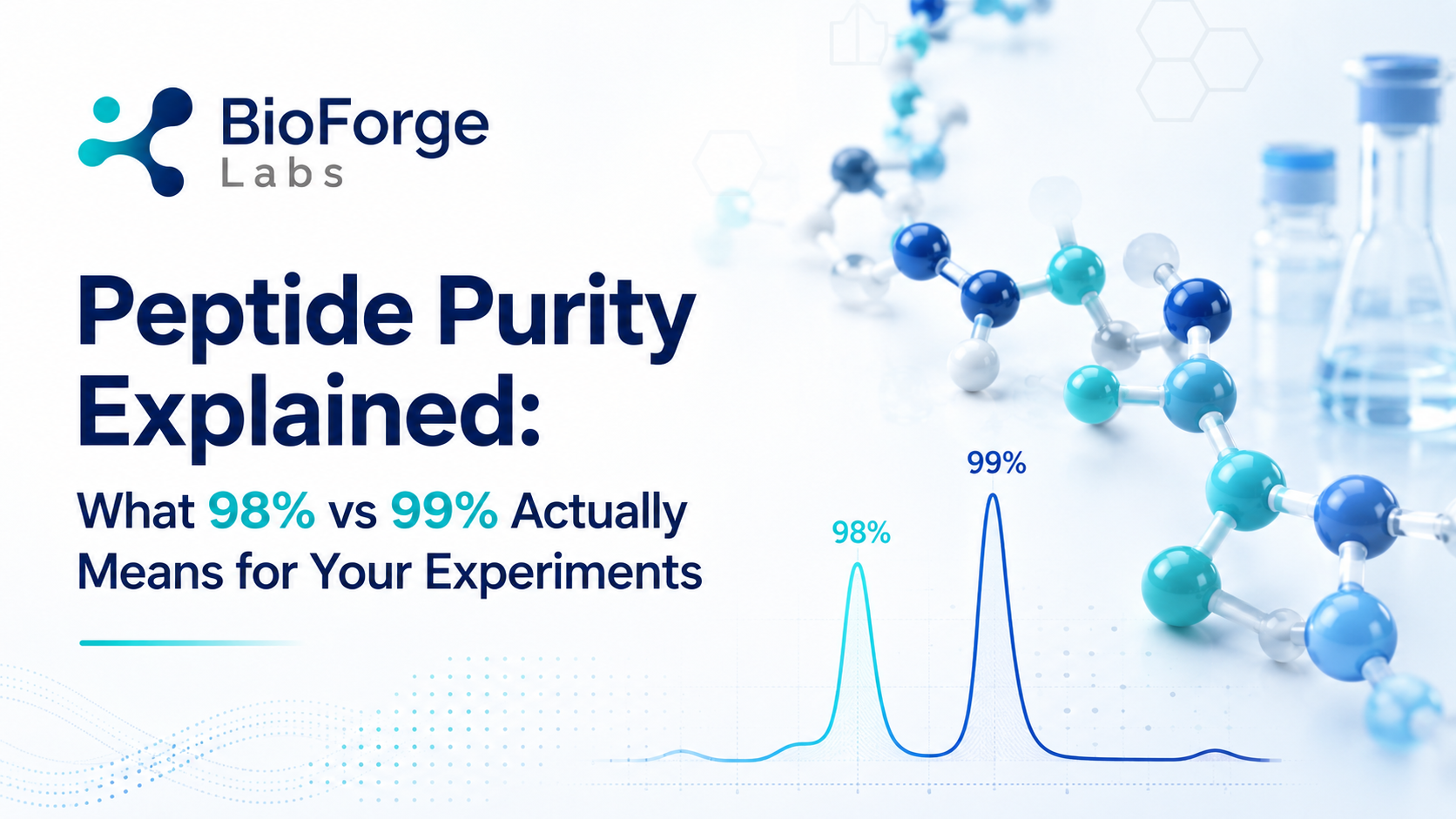
Peptide purity is typically determined by reverse-phase High-Performance Liquid Chromatography (HPLC) with UV detection. The instrument separates components in the sample and calculates the area of the main peak (the target peptide) as a percentage of the total detected peak area.
A reported purity of 99% means that approximately 99% of the UV-absorbing material detected corresponds to the intended peptide sequence. The remaining 1% consists of related impurities generated during synthesis or handling, such as:
- Truncated or incomplete sequences
- Deletion or insertion peptides
- Oxidised or deamidated forms
- Residual protecting groups
- Other process-related peptide impurities
Importantly, HPLC purity is a relative measurement of the peptide-related material. It does not automatically tell you how much of the total vial weight is actual peptide versus non-peptide components such as counter-ions (commonly TFA), residual water, or salts.
HPLC Purity vs Net Peptide Content
This distinction is critical for accurate experimental work.
- HPLC purity answers: “Of the peptide material present, what percentage is the correct sequence?”
- Net peptide content answers: “What percentage of the total powder weight is actually peptide?”
A vial can legitimately show 99% HPLC purity while containing significantly less than the labelled mass of peptide by weight, because water and counter-ions are invisible to standard HPLC UV detection. Comprehensive Certificates of Analysis that report both values give researchers a more complete picture.
98% vs 99%: Practical Significance in Research
Both 98% and 99% HPLC purity are generally regarded as research-grade when supported by proper identity confirmation (mass spectrometry) and transparent testing.
When the difference matters more:
- Highly sensitive assays (e.g. receptor binding, precise dose-response studies)
- Experiments where impurities could produce off-target effects
- Work requiring maximum batch-to-batch consistency
- Quantitative studies where small variations in active material are critical
When 98% is typically sufficient:
- Many standard cell-based assays
- Screening or preliminary experiments
- Applications where the impurity load at ≤2% is unlikely to meaningfully affect results
In practice, the reliability of the testing data and the consistency between batches often matter more than the single percentage point difference between 98% and 99%.
Why Independent Testing Is Essential
A stated purity figure is only as trustworthy as the supporting data. Researchers should prioritise:
- Batch-specific Certificates of Analysis from independent laboratories (e.g. Janoshik or equivalent)
- Clear HPLC chromatograms
- Mass spectrometry confirmation of molecular identity
- Quantity or weight verification where available
- Recent testing dates
Supplier claims of “99% pure” without transparent third-party documentation carry higher uncertainty.
Practical Recommendations for Laboratory Researchers
- Request or review the full CoA for every batch.
- Distinguish between HPLC purity and net peptide content when both are reported.
- Match purity expectations to the sensitivity of your experimental system.
- Store peptides correctly after receipt — degradation after arrival can reduce effective purity regardless of the original specification.
- Record batch numbers and CoA details for experimental traceability and reproducibility.
BioForge Labs Approach to Purity Transparency
At BioForge Labs, we supply research peptides with independent testing documentation so laboratories can evaluate purity and identity with confidence. Transparent quality information supports more reliable experimental design and interpretation.
All products are sold strictly for research and laboratory use only.
Key Takeaways
- HPLC purity measures the proportion of the correct peptide among detected peptide-related material.
- 98% and 99% are both considered research-grade when properly verified; the practical difference depends on the experiment.
- Net peptide content is a separate and equally important metric.
- Independent, batch-specific testing is more important than the headline purity number alone.
- Correct storage and handling protect the purity that was present at the time of testing.
For further reading on the distinction between purity measurements and overall peptide quality assessment, see this detailed explanation: Peptide Purity Explained: What ≥99% HPLC Purity Actually Means for Research
Final Thoughts
Understanding what peptide purity numbers actually represent allows researchers to interpret supplier data more accurately and design experiments with appropriate expectations. High initial purity is valuable, but it is most useful when combined with transparent testing, identity confirmation, and careful laboratory handling.