How Research Peptides Are Manufactured
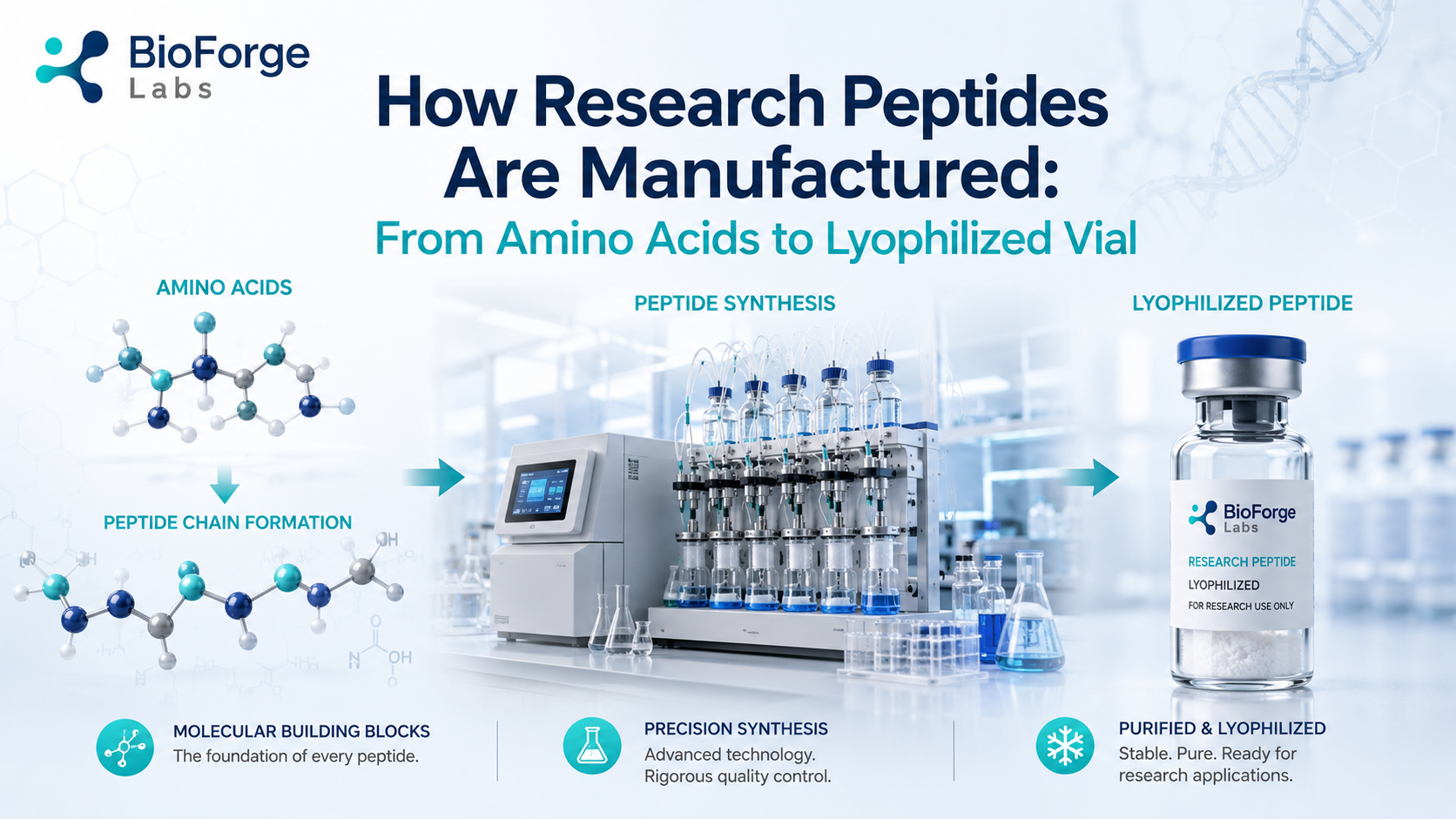
Understanding how research peptides are manufactured helps laboratories interpret quality data, compare suppliers, and recognise why independent testing matters. Most research-grade peptides sold today are produced by chemical synthesis rather than extracted from biological sources. The dominant industrial method is solid-phase peptide synthesis (SPPS), followed by purification and freeze-drying.
This guide outlines the main manufacturing steps used for research peptides, the points where quality is won or lost, and what Australian researchers should look for when evaluating finished material.
The Core Manufacturing Pathway
A typical research peptide batch follows this sequence:
- Sequence design and raw-material selection
- Stepwise chain assembly (usually Fmoc SPPS)
- Cleavage from the resin and removal of protecting groups
- Crude isolation
- Preparative HPLC purification
- Lyophilization (freeze-drying)
- Quality control and documentation
Each step can introduce or remove impurities. Final HPLC purity is largely determined by how well synthesis and purification are controlled.
Step 1: Solid-Phase Peptide Synthesis (SPPS)
Modern research peptides are almost always built using Fmoc solid-phase peptide synthesis, introduced by Bruce Merrifield and now the industry standard.
The growing peptide chain is anchored by its C-terminus to an insoluble resin bead. Amino acids are added one at a time in a repeating cycle:
- The temporary Fmoc protecting group is removed (typically with piperidine)
- The next protected amino acid is coupled using an activator
- Excess reagents and by-products are washed away
- The cycle repeats until the full sequence is assembled
Because the peptide stays attached to the resin, excess reagents can be used to drive each coupling toward completion, then simply filtered away. This is far more practical than classical solution-phase synthesis for most research sequences.
Common challenges during assembly include incomplete couplings, deletion sequences, aggregation of longer or hydrophobic peptides, and side reactions at sensitive residues.
For a clear technical overview of the SPPS cycle, see Bachem’s explanation of Solid Phase Peptide Synthesis (SPPS).
Step 2: Cleavage and Deprotection
Once the sequence is complete, the peptide is cleaved from the resin and side-chain protecting groups are removed. This is usually done with a strong-acid cocktail based on trifluoroacetic acid (TFA), plus scavengers to protect sensitive residues.
The crude peptide is then precipitated, washed, and collected. At this stage the material still contains truncated sequences, deletion peptides, residual reagents, and other process-related impurities. Crude purity can vary widely depending on sequence difficulty and synthesis quality.
Step 3: Preparative HPLC Purification
Purification is where research-grade quality is actually created.
The crude peptide is dissolved and separated by preparative reversed-phase HPLC, typically on a C18 column using a water/acetonitrile gradient with an acidic ion-pairing agent such as TFA. Related impurities elute at different times; only the fractions corresponding to the target peptide are collected.
This step determines:
- Final HPLC purity
- The impurity profile
- How much residual TFA remains as a counter-ion
Poor purification cannot be fixed later. Aggressive or poorly controlled chromatography can also reduce yield or leave closely related impurities in the final product.
For an industrial perspective on large-scale peptide synthesis and purification, see this RSC Advances review on peptide manufacturing.
Step 4: Lyophilization
Purified peptide fractions are pooled, frozen, and freeze-dried under vacuum. Lyophilization removes water and produces the familiar white to off-white powder supplied in research vials.
This step is important because:
- Peptides in aqueous solution degrade much faster than dry solids
- Residual moisture can accelerate later degradation
- The finished powder is easier to store, ship, and handle in the laboratory
The lyophilized product typically contains the peptide plus counter-ions (often TFA) and a small amount of residual water. That is why HPLC purity and net peptide content are not the same measurement.
Step 5: Quality Control
A complete research-grade manufacturing process ends with analytical testing, commonly including:
- Analytical HPLC for purity
- Mass spectrometry for identity
- Quantity or content verification
- Sometimes additional checks such as endotoxin or residual solvent testing
Independent third-party Certificates of Analysis give researchers a way to verify these results rather than relying only on in-house claims.
Other Manufacturing Routes
Not all peptides are made the same way:
- Recombinant production is used for some larger proteins and certain commercial hormones
- Liquid-phase / fragment synthesis may be used for specific sequences or larger-scale work
- Hybrid approaches combine chemical fragments with ligation methods for longer peptides
For most of the research peptides commonly used in laboratory studies, Fmoc SPPS plus HPLC purification remains the standard route.
What This Means for Researchers
Understanding manufacturing helps explain several practical points:
- Purity depends on both synthesis quality and purification quality
- Closely related impurities are often synthesis by-products, not random contaminants
- TFA and residual water can make up a meaningful portion of vial weight
- Storage after manufacture still matters — a well-made peptide can degrade if mishandled
- Batch-specific testing is more useful than generic “99% pure” claims
Australian Research Context
For laboratories in Australia, manufacturing quality is only part of the picture. Temperature during shipping, documentation, and the availability of independent CoAs all affect whether the material arriving in the lab still matches the intended specification.
Domestic suppliers who understand cold-chain handling and provide transparent batch data make it easier to maintain experimental reliability.
BioForge Labs
At BioForge Labs, we supply research peptides intended for laboratory use, with a focus on independent testing documentation and careful handling. Understanding how peptides are manufactured helps researchers interpret CoAs and choose materials appropriate for their experimental design.
All products are sold strictly for research and laboratory use only. They are not intended for human consumption, therapeutic, or veterinary purposes.
Key Takeaways
- Most research peptides are manufactured by Fmoc solid-phase peptide synthesis
- Purification by preparative HPLC is the step that largely determines final purity
- Lyophilization converts the purified peptide into a stable dry powder
- HPLC purity does not measure net peptide content
- Independent batch testing is the best way to verify the finished material