Free delivery and 10ml BAC Water on orders over $200

$0.00
Free Shipping on All Orders Over $200
How to Properly Reconstitute Research Peptides (Step-by-Step 2026)
Important Research Disclaimer: This guide is provided for research and laboratory purposes only. All peptides sold by BioForge Labs are strictly for in vitro or in vivo research use and are not intended for human or veterinary consumption. Always follow institutional guidelines, local regulations (including TGA in Australia), and consult relevant scientific literature. Improper handling may compromise research integrity.
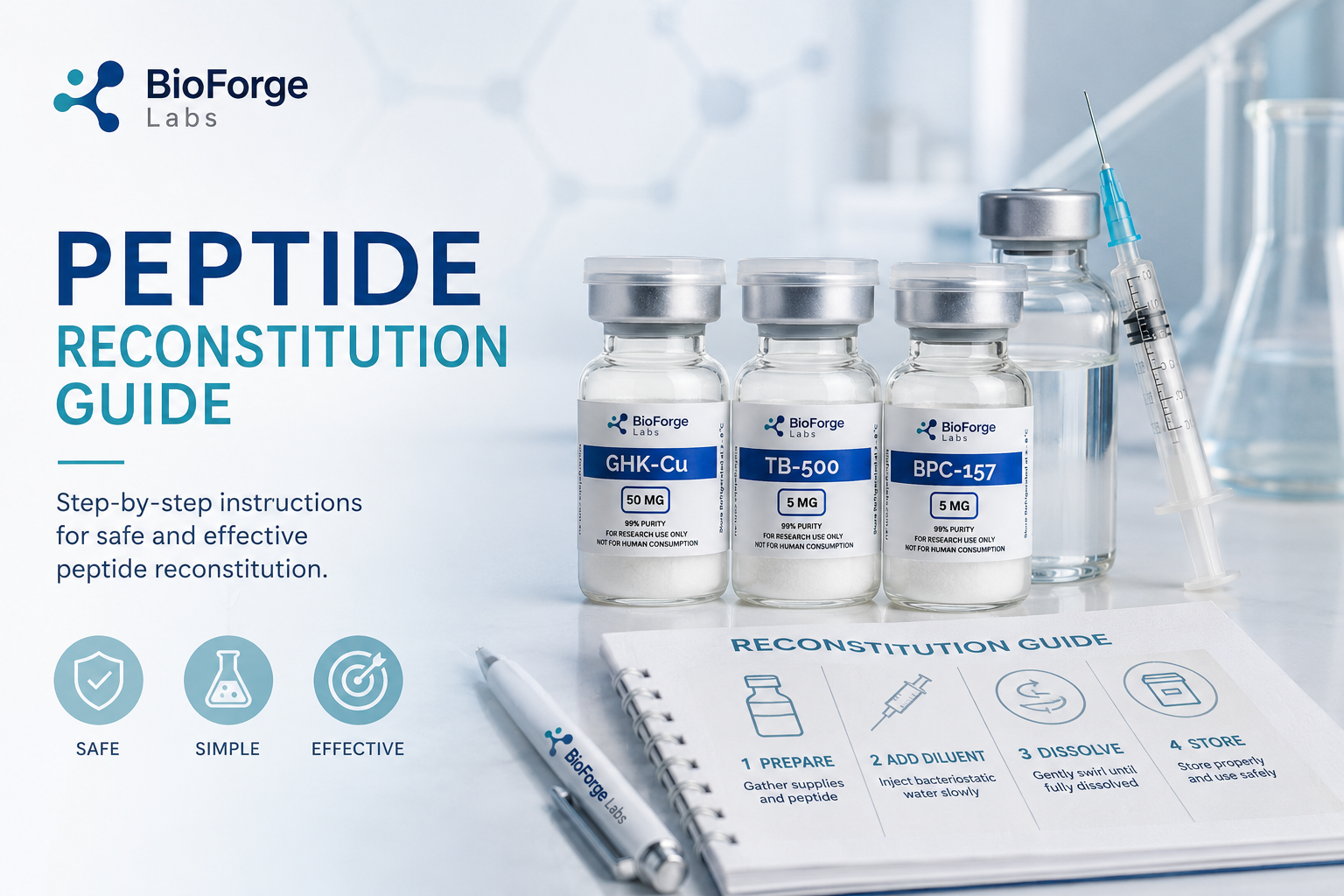
What Is Peptide Reconstitution and Why Does It Matter?
Most research peptides are supplied as lyophilized (freeze-dried) powder in sterile vials. Reconstitution is the process of adding a solvent—typically bacteriostatic water—to dissolve the powder into a usable liquid form for accurate dosing in laboratory settings.
Proper reconstitution ensures:
- Full peptide solubility and stability.
- Accurate concentration for dosing calculations.
- Minimized degradation from improper mixing or contamination.
Incorrect technique can lead to reduced potency, aggregation, or inaccurate research data.
Materials Needed for Peptide Reconstitution
- Lyophilized peptide vial(s) from a reputable supplier like BioForge Labs (≥99% purity, third-party tested).
- Bacteriostatic water (BAC water) – sterile water with 0.9% benzyl alcohol.
- Sterile syringes (e.g., 1mL or 3mL insulin syringes with fine needles).
- Alcohol swabs / prep pads.
- Clean workspace (ideally a laminar flow hood for advanced lab work).
- Optional: Peptide reconstitution calculator (online tools available), gloves, and vial labels.
Pro Tip: Allow vials to reach room temperature before starting to avoid condensation.
Step-by-Step Peptide Reconstitution Instructions
- Prepare Your Workspace Wash hands thoroughly. Disinfect your work surface. Gather all materials.
- Sanitize Vials Wipe the rubber stoppers of both the peptide vial and bacteriostatic water vial with alcohol swabs. Let them air dry completely.
- Calculate the Amount of Bacteriostatic Water Decide your desired concentration. Common examples:
- For a 5mg peptide vial: Add 2mL BAC water → 2.5mg/mL concentration.
- Use a peptide calculator for precision: Input peptide mg, BAC water volume (mL), and desired dose (mcg) to determine syringe units.
- Draw Bacteriostatic Water Use a sterile syringe to draw the calculated volume of BAC water. Inject a small amount of air into the BAC water vial first to balance pressure if needed.
- Add Solvent to Peptide Vial Insert the needle at a slight angle into the peptide vial. Slowly inject the water down the side of the vial (not directly onto the powder) to minimize foaming and shear stress.
- Mix Gently Remove the syringe. Gently swirl or roll the vial between your fingers until the powder fully dissolves. Never shake vigorously — this can damage the peptide structure.
- Let It Settle Allow the vial to sit for 5–15 minutes if needed for complete dissolution. Inspect for clarity (no visible particles).
- Label and Store Label the vial with date, concentration, and peptide name. Store immediately in the refrigerator (2–8°C).
Peptide-Specific Reconstitution Notes
- BPC-157, TB-500, GHK-Cu: Usually reconstitute easily with BAC water (1–2mL per 5–10mg vial).
- Semaglutide, Tirzepatide, Retatrutide: Follow precise calculations due to potency. These are highly sensitive — use conservative volumes for accuracy.
- Always check your specific research protocol or supplier recommendations. Some peptides may benefit from different solvents in advanced lab settings (e.g., acetic acid for certain sequences), but BAC water is standard for most.
Storage Guidelines for Reconstituted Peptides
- Refrigerated (2–8°C): Most reconstituted peptides remain stable for 4–8 weeks (or longer depending on the peptide). Do not freeze reconstituted solutions.
- Lyophilized Powder: Stable for months to years when stored at -20 °C, dark, and dry.
- Protect from light, heat, and repeated temperature fluctuations.
- Discard if solution becomes cloudy or contains particles.
Common Mistakes to Avoid
- Shaking the vial aggressively.
- Injecting solvent directly onto the powder.
- Using non-sterile water or expired materials.
- Incorrect calculations leading to dosing errors.
- Storing at room temperature for extended periods.
Troubleshooting Reconstitution Issues
- Powder not dissolving: Gently swirl longer or warm the vial slightly in your hands (avoid heat sources).
- Foaming: Add solvent more slowly next time.
- Cloudy solution: May indicate contamination or incompatibility — discard and start fresh.
FAQ – Peptide Reconstitution
How much bacteriostatic water should I add? It depends on your desired concentration. Use a reliable peptide reconstitution calculator for accuracy.
Can I use sterile water instead of bacteriostatic? Bacteriostatic water is preferred for multi-dose vials as it inhibits bacterial growth. Sterile water is suitable for single-use but has a shorter window.
How long do reconstituted peptides last? Typically 4–6+ weeks refrigerated. Always verify with stability data for your specific peptide.
Do I need special equipment? Basic sterile syringes and alcohol wipes suffice for standard lab procedures.
For more details on our products, visit our shop page or contact us for batch-specific CoAs.
Final Research Best Practices
- Work in a sterile environment where possible.
- Track lot numbers and reconstitution dates.
- Document all procedures for reproducibility in your research.
This guide is optimized to help researchers achieve consistent, high-quality results with research-grade peptides from BioForge Labs. Bookmark it for reference and share with your lab team.